

Tsuji Gettan Sukeshige (辻月丹祐茂)
Founder of Mugai Ryu
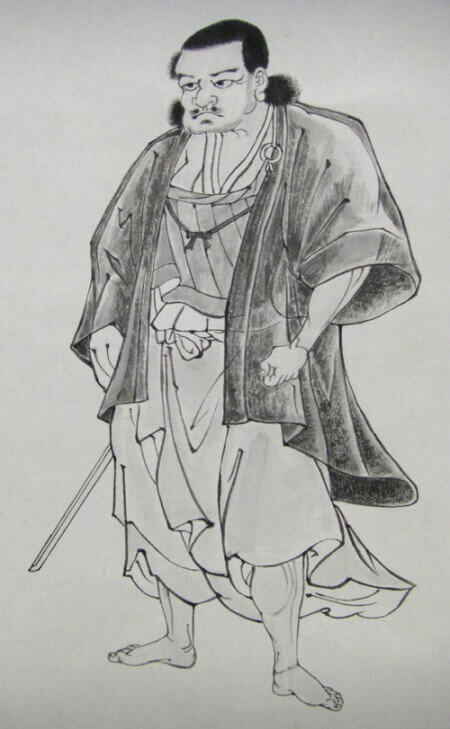
Tsuji Gettan Sukeshige was born in 1648 in what is now Shiga Prefecture, Japan, during the early Edo period—a time of relative peace in which the role of the samurai was increasingly defined not by constant warfare, but by discipline, ethics, and self-cultivation.
At the age of thirteen, Gettan traveled to Kyoto to study at the Yamaguchi Dōjō, where he trained extensively in swordsmanship and various forms of iai. During these formative years, he was exposed to multiple schools and methods, developing a broad technical foundation rather than strict adherence to a single tradition. This period shaped his later belief that true mastery required understanding principles beyond fixed forms.
In his mid-twenties, Gettan attempted to establish his own school, but the effort was unsuccessful. Rather than persisting through force of reputation alone, he withdrew from public teaching and entered Azabu Kyūkō-ji Temple, where he devoted himself to Zen training. There, under rigorous discipline, he deepened both his meditation practice and his understanding of the sword—not as a tool of aggression, but as a vehicle for clarity, presence, and correct action.
Through decades of combined Zen practice and martial refinement, Gettan gradually articulated the philosophical foundations that would later define Mugai-ryū. Central to his approach was the rejection of excess: no unnecessary movement, no reliance on brute strength, and no attachment to ego. Technique was to arise naturally from awareness, timing, and correct intent.
At the age of forty-five, Gettan is said to have attained satori—enlightenment—through Zen practice. From this point onward, his teaching fully embodied the principle that swordsmanship and Zen were not separate pursuits, but expressions of the same truth. The name Mugai (無外), meaning “outward nothingness,” reflects this understanding: when action is correct, nothing lies beyond the present moment.
Gettan later founded Mugai-ryū in 1693 and opened a dōjō that attracted many high-ranking samurai and daimyō. He became widely respected not only as a master swordsman, but also as a Zen scholar and teacher. His instruction emphasized calm observation, decisive action, and the cultivation of character—qualities expected of a warrior in a peaceful era.
In his seventy-first year, Gettan was granted the rare honor of an audience with the shōgun, recognition of his reputation and influence. The meeting ultimately did not occur due to the shōgun’s death shortly beforehand. Tsuji Gettan Sukeshige passed away in 1728 at the age of seventy-nine, reportedly seated in deep meditation.
His legacy endures through Mugai-ryū Iaido, a tradition that continues to emphasize clarity over force, presence over speed, and inner stillness expressed through precise, decisive movement.
Gettan’s Poem
一法実無外
乾坤得一貞
水毛本来密
動着即光精
“Ippo jitsu mugai
Kenkon toku ittei
Suimo hono mitsu
Dochaku soku kosei”
“There is nothing but this one truth
it’s all-encompassing and everlasting
a feather carried by the winds upholds this truth.
To experience harmony in the face of confusion
is enlightenment.“