
Eric Weiland
Bashochou of Tenshinkai Dojo New Jersey
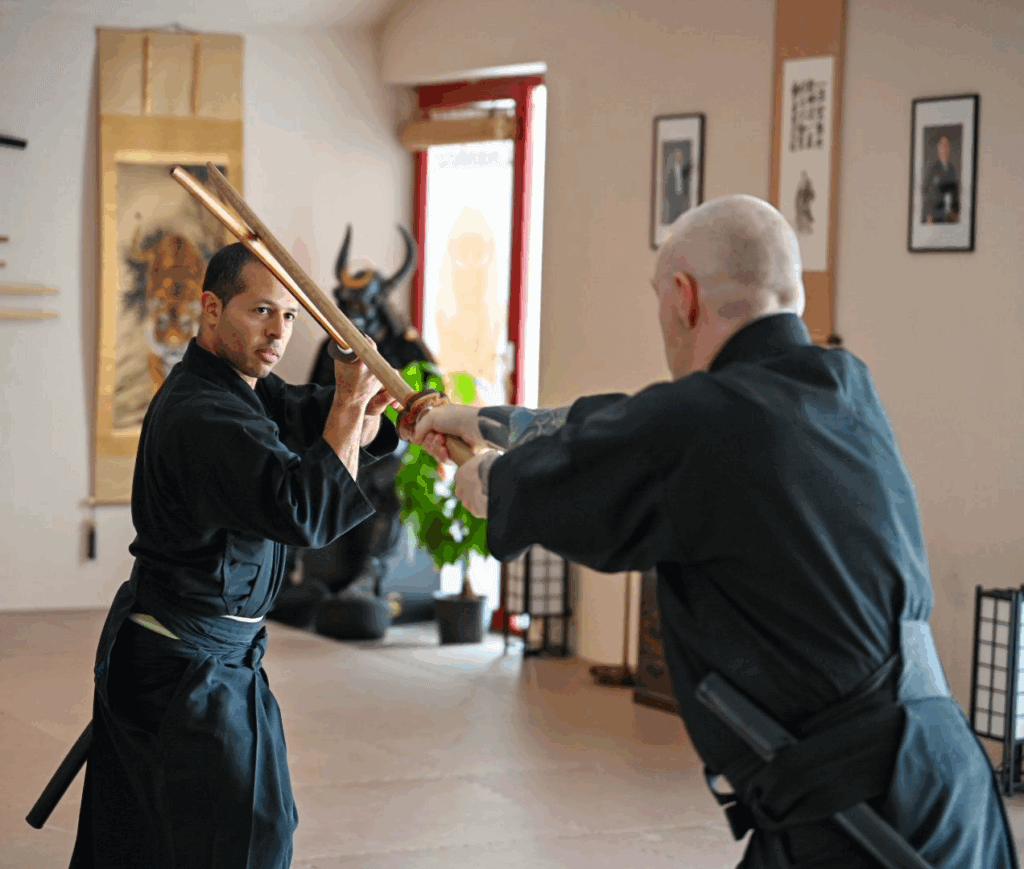
My journey in Iaido began during college when a friend invited me to attend a class. From the moment I stepped onto the dojo floor, I was hooked. Unfortunately, Iaido dojos were rare—and too far from campus for regular practice—so I trained in American Family Kenpo throughout my college years in Massachusetts.
After returning home to New Jersey, I found that Iaido remained difficult to access. In the meantime, I devoted myself to other physically and mentally demanding pursuits like ice hockey, rock climbing, mountain biking, and sailing. These helped me maintain the self-discipline and physical fitness instilled through martial arts, but I always kept searching for a path back to the sword.
That path opened after the pandemic, when I discovered Mugai Ryu Meishi-ha under Sensei Luciano Morgenstern in Köln, Germany. I was immediately drawn to its balanced focus on Iaido, Kenjutsu, and Tameshigiri, along with its deep respect for Zen and the spirit of the Samurai. I’ve now been training solely in Mugai Ryu for the past three years, and it has become a source of focus, clarity, and cultural connection amid the chaos of daily life.
In parallel with training, I’ve immersed myself in the study of samurai history and the legacy of nihonto (Japanese swords). I’m honored to be the caretaker of a 500-year-old Sukesada wakizashi—a tangible link to the warriors of the past and a constant reminder of the responsibility we carry in preserving these traditions.
My journey into Budo, Bushido, and the way of the modern Samurai is still unfolding—and I’m honored to share what I’ve learned so far. I invite you to join us in this path of discipline, stillness, and strength. Ganbatte kudasai.
“The primary thing when you take a sword in your hands is your intention to cut the enemy, whatever the means. Whenever you parry, hit, spring, strike or touch the enemy’s cutting sword, you must cut the enemy in the same movement. It is essential to attain this. If you think only of hitting, springing, striking or touching the enemy, you will not be able actually to cut them.”
— Miyamoto Musashi, The Book of Five Rings
“By knowing things that exist, you can know that which does not exist. That is the void. People in this world look at things mistakenly and think that what they do not understand must be the void. This is not the true void. It is confusion. In the Way of Strategy, also, those who study as warriors think that whatever they cannot understand in their craft is the void. This is not the true void. The true void is where there is nothing, and there is no gaining or losing. It is the state of perfect harmony, where one sees with clarity and acts without hesitation. This is the state of mind which is calm and clear.”
— Miyamoto Musashi, The Book of Five Rings, Book of the Void