

Mugai Ryu Iaido & Kenjutsu
A Classical Japanese Samurai Martial Art
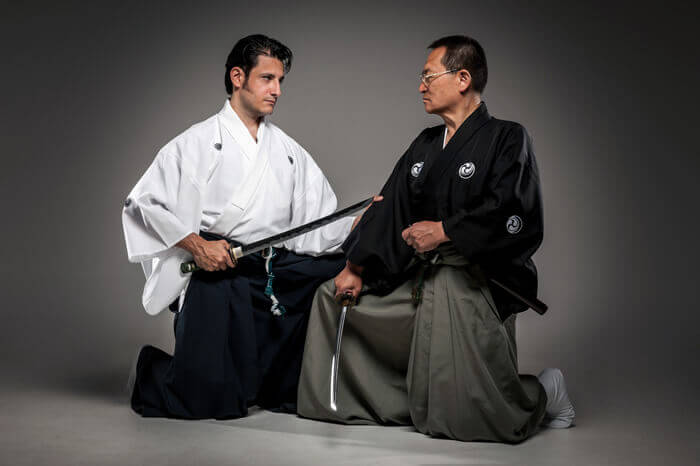
Mugai-ryū is a classical Japanese sword tradition centered on the use of the katana. Rooted in the culture of the samurai, it reflects the values expected of the warrior class during Japan’s Edo period: discipline, responsibility, restraint, and clarity of action.
While often associated with combat, the sword in Mugai-ryū is also a tool for self-cultivation. Training emphasizes correct movement, presence of mind, and decisive action, expressed through formal kata and paired practice rather than competition.
Mugai-ryū as a Kenjutsu Tradition
Mugai-ryū was established as a classical kenjutsu tradition, with paired sword practice (kumitachi) at its core. From its founding, the art emphasized applied swordsmanship—distance, timing, intent, and decisive action—expressed through direct engagement with an opponent rather than abstract form alone.
Paired practice in Mugai-ryū serves as the foundation for understanding the sword. Through kumitachi, practitioners study not only technique, but judgment, awareness, and composure under pressure. This emphasis reflects the realities faced by samurai during the Edo period, when the ability to respond correctly to another person’s intent was central to martial training.
While solo forms and sword-drawing methods are essential to Mugai-ryū practice, they were historically understood as complementary disciplines, supporting the development of correct movement and mindset for paired application.
Kenjutsu and Kumitachi
Kenjutsu refers broadly to the classical Japanese art of swordsmanship—the principles, strategies, and techniques governing the use of the sword against an opponent. It encompasses how distance is managed, how timing is read, how intent is perceived, and how decisive action is taken under pressure.
Kumitachi, meaning “paired sword,” is a method of training within kenjutsu. It consists of structured, prearranged encounters between two practitioners, allowing the principles of kenjutsu to be studied directly through interaction. Kumitachi is not free sparring, nor is it symbolic choreography; it is a disciplined form of paired practice designed to transmit correct distance, timing, and intent.
In Mugai-ryū, kenjutsu is expressed primarily through kumitachi. The paired forms serve as the core vehicle through which sword principles are learned and embodied. Solo practice, including iai, supports this foundation by refining posture, cutting mechanics, and mental composure, but does not replace the study of the sword in relation to another person.
Understanding this distinction helps clarify why Mugai-ryū places such importance on paired practice: the sword is ultimately a relational discipline, defined by the presence and intent of an opponent.
Mugai-ryū and Jikyō-ryū
The iaido practiced within Mugai-ryū originates from Jikyō-ryū Iaijutsu, a sword-drawing tradition founded by Taga Jikyōken Morimasa. The founder of Mugai-ryū, Tsuji Gettan Sukeshige, studied Jikyō-ryū directly under Taga and transmitted this teaching through successive generations of the Tsuji family.
As time passed, practitioners of Mugai-ryū continued to preserve and teach Jikyō-ryū iai alongside Mugai-ryū’s own classical sword methods. When it became clear that Jikyō-ryū would not continue beyond its sixth-generation sōke, formal transmission of Jikyō-ryū was entrusted to Mugai-ryū practitioners, ensuring its preservation.
For this reason, the iaido component taught within Mugai-ryū is historically Jikyō-ryū in origin, though it is commonly referred to today as Mugai-ryū Iaido.
Modern Mugai-ryū
In the modern era, Nakagawa Shiryu Shinichi, the 11th sōke of Mugai-ryū, played a central role in reorganizing and revitalizing the tradition. His efforts unified the transmission of Jikyō-ryū Iaido with classical Mugai-ryū swordsmanship, giving structure to what became known as Mugai-ryū Iaihyōdō.
Following this period of reorganization, Mugai-ryū continued to be transmitted through multiple lines of instruction. Niina Toyoaki, the current Gosōke, preserves and transmits Mugai-ryū Meishi-ha, a lineage that emphasizes correct cutting, paired practice, and direct application rooted in the classical principles of the art.
Under his guidance, Mugai-ryū Meishi-ha continues as a living martial tradition, balancing faithful preservation with disciplined, functional practice.
Practice Today
Training in Mugai-ryū consists of solo iai kata, paired kenjutsu, and related foundational exercises. Practice is non-competitive and emphasizes:
- correctness over speed
- awareness over strength
- and composure under pressure
The goal is not performance, but refinement—of movement, judgment, and character.